

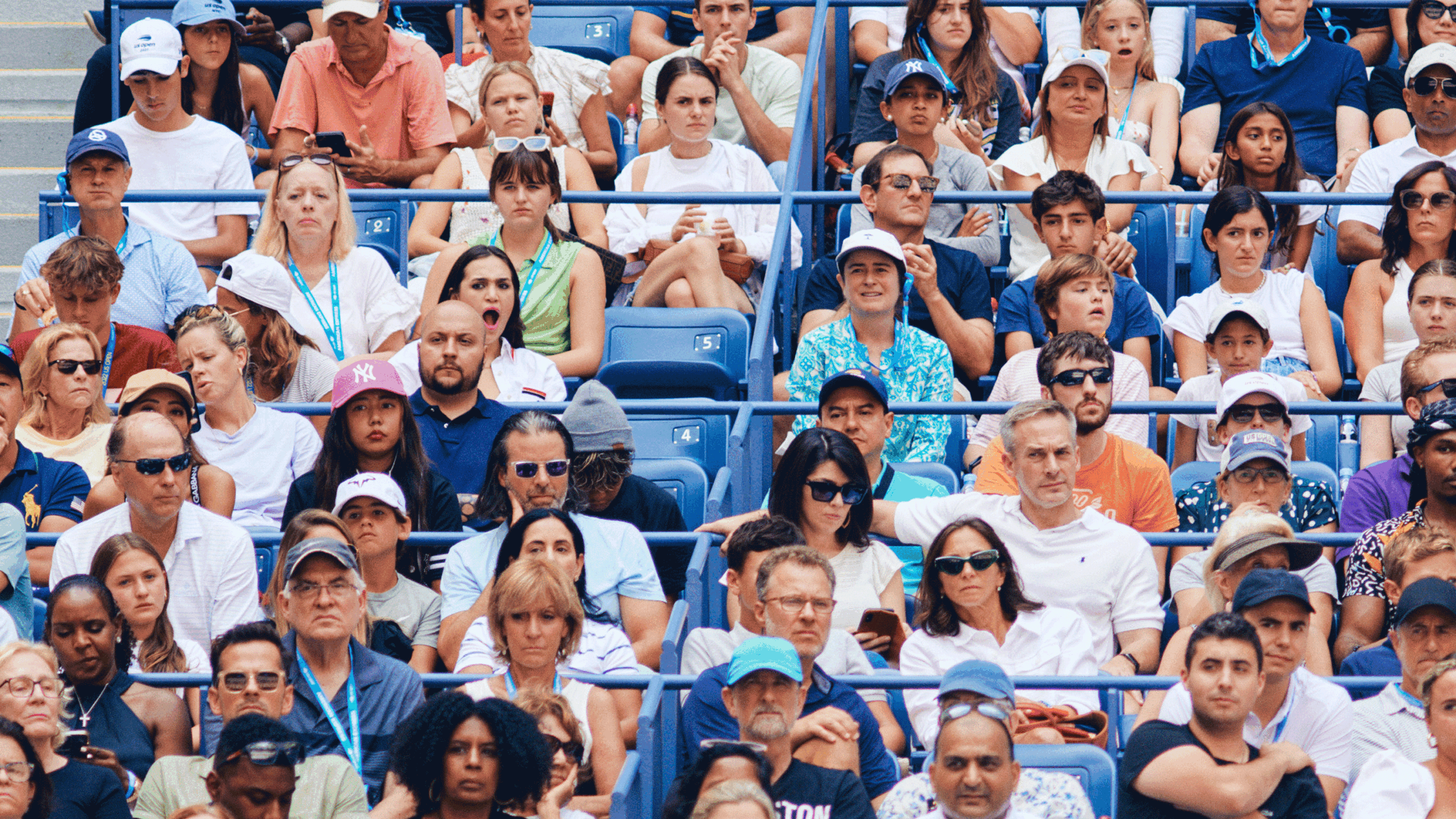
Hey, we heard the amazing news: You’re headed out to the US Open! Maybe you paid for the tickets (and, yeah, we know: they seem to be getting rather pricey), or maybe you’ve been among the select few invited by a brand to watch the action from their well-appointed suite. Either way, awaiting you is an array of sensorial delights, from chicken nuggets topped with Petrossian caviar and crème fraiche to the infamous Honey Deuce cocktail; the glamorous, see-and-be-seen atmosphere of Arthur Ashe Stadium (soundtracked by DJ Trizz), where Travis Scott, Kaia Gerber, Homer Gere, Orlando Bloom, and Queen Latifah (to name but a few) have already visited in the early days of this year’s tournament; and, oh yeah, some great tennis.
If that last part seems like a bit of an afterthought, we’ve got some helpful advice for you. Maybe you’ve been among the 1.5 million people clearing their throats and raising a finger in outrage after viewing the now-notorious viral videos of influencers supposedly ruining tennis for everybody the other night, or maybe you’re an influencer—or have hopes and dreams of being one—yourself.
Let’s first catch you up and dispense with a few too-easy truisms: Yes, the crowds at the Open are bigger than ever; and yes, there do seem to be more influencers in attendance than ever before, with the press office of the United States Tennis Association (the sport’s governing body in the US, which owns and oversees the Open) issuing about 100 credentials this year for content creators, as the influencer genus is formally known.
Yeah, there have been issues
And, yeah, there have been issues. After a boisterous group armed with ring lights on stands seemed to be capturing content on the balcony of their suite during Naomi Osaka’s late-night opening match against Anastasia Zakharova—not between games or even between points, but while the players were competing—the baritone-voiced chair umpire, Kader Nouni (who is, incidentally, known among insiders as the Barry White of tennis) was forced to reprimand the group.
“Guys, please, in the suite behind me,” Nouni pleaded, his voice utterly bereft of sensuality or seduction, “please, thank you guys, please take your seat.”
Osaka, who was asked about the situation after her second-round win on Thursday, was her usual thoughtful self in response. “Obviously, if you come to a sporting event, you have to respect the sport,” she said, “and I feel like it’s common courtesy to read up on the sport, especially the etiquette.
It could be a good thing for people to make the sport of tennis popular to their specific audience,” she continued, “but it has to be managed a lot better, especially in a situation like my first-round match.”
I mean, it couldn’t be more clear: Influencers bad…. Right? Sadly, it’s not quite so simple, and we’ll get to why in a moment. But here’s another of the other complaints about this year’s Open: The din in Arthur Ashe Stadium is out of control.
Watch a match at Wimbledon’s Centre Court,
Watch a match at Wimbledon’s Centre Court, and you can hear a pin drop. Part of that magic is about acoustics, of course; comparing the grass carpet of an open-air Centre Court to the massive echo chamber of a closed-roof Ashe Stadium (which also holds about 10,000 more fans) on a rainy day or night is a fool’s errand. It’s also worth noting that many people (including me) complained about the noise from the moment Ashe opened in 1997—but, yeah, it’s a thing, and yeah, it seems to be getting worse.
But is this the fault of influencers? No—it’s the fault of ticket prices. With resellers scooping up a huge swath of the Open’s face-value tickets and unloading them at whatever price the (admittedly flush) market will bear, more and more fans in Ashe have little or no interest in what’s actually happening on the court. They’re there to relate the breathtakingly unremarkable 25-minute story of their time “cowboyin’” on a dude ranch in Wyoming in the 1960s, as the elderly gentleman directly behind me in one of the stadium’s most exclusive boxes did a few nights ago, or to tell their seatmate the intricate and riveting tale of how their neighbor Phyllis has gone “completely off her rocker,” as the lady sitting next to me yesterday did.
“Do I care a whit about her personal business?” the woman said, her shrill voice reaching a worrisome crescendo. “No—but am I supposed to just sit around and take care of everything for her? I don’t think so!”
I braced myself for the chair umpire’s swift retribution—perhaps, even, the woman’s ejection. Instead, a not-elderly man a few rows away—perhaps even more disturbed by the tale of Phyllis’s downfall than I—became convulsed in a seizure.
(He regained consciousness and composure and was taken
(He regained consciousness and composure and was taken away in a wheelchair by medics; I soon followed, but under my own steam.)
Yet this problem isn’t limited to tennis no-nothings. At another match yesterday, in Armstrong Stadium, I found myself yet again downwind from a too-loud, too-constant monologue, this one about the tedious inner workings of a mid-America tennis tournament—and when I turned my head in the direction of the annoyance, I learned from the laminate around his neck that the perpetrator worked for the USTA.
All this to say: Blaming “influencers” is simply the easy, empty-calorie burn of the moment; it’s like blaming “the media” for everything you don’t like about modern life. Could we all live more in the moment instead of needing to flex an Instagram Story about how much fun we’re having all the time? Sure—but for every duck-lipped influencer who simply must take 147 shots of herself holding a Honey Deuce while wrapped in the bosom of #suitelife, there’s another one out there delivering actual information and inspiration.
(Dylan Gee recently documented bringing “the reason I first picked up a tennis racket,” a.k.a. his mom, to the Open for the first time, while Eliza Wastcoat delivered a host of inside tips on getting the most out of the Open—one of them being, skip the Honey Deuce for the Frozen Honey Deuce, served at only one location onsite.)
What many of those shaking a proverbial stick at the “influencer problem” are really mad about is this: Tennis—and in particular, the US Open—isn’t what it used to be.
I concede this point
I concede this point. In 1972, before Billie Jean King succeeded in forcing the Open to become the first to pay women and men equally, she was paid $10,000 for her win, while Ilie Nastase made $25,000 for his. This year’s men’s and women’s winners will each make a record $5.5 million. Food at the Open also used to mean hot dogs and hamburgers, and before the advent of the Honey Deuce, the drink options were simple: there was beer and there was soda.
The sport itself was, for some time, considered to be on its way to slow extinction. There’s a very lively discussion to be had about whether the recent rock-n’-rollification of tennis has gone too far. What’s not up for debate, in our current, post-Challengers moment, is whether or not tennis—and the US Open—is more popular than ever. As the New York Times noted in a recent piece: “With its unique combination of high-end clientele and huge attendance—a record 1.14 million fans went last year—the US Open boasts both the aristocratic spending power of a polo match with the populist volume of an NFL franchise.”
Indeed, the Open has more or less the same number of fans pass through its gates in 15 days as the New York Giants and New York Jets have—combined—over the entirety of their football seasons at MetLife Stadium in New Jersey, and it brings more revenue to New York City than the entire 162-game seasons of the Mets and Yankees combined.
Yes, some of those people are incredibly annoying—and some of those people aren’t even fans. Like it or not, there are a few stringent matters of etiquette unique to the game that, as Osaka noted earlier, need to be respected. So, herewith, our non-negotiable, no-nonsense rules for behavior at the US Open:
Never, ever stand up and move around while the players on court are playing points.
This one’s hard and fast, and violating
This one’s hard and fast, and violating it might get you called out by the chair umpire. It’s less about formality and more about distraction: Playing tennis—in particular, returning a serve that might reach speeds of 150 mph—in front of 14,000 people requires an immense amount of concentration, and you blithely walking down the aisle and pointing at the seats you think might be yours simply isn’t helpful.
When the players change sides on the court (after every two games), that’s your window to move as well. Feel free to talk (sotto voce and, ideally, entre nous)—and yell as loud and as much as you’d like…after the point. Again, the Open isn’t Wimbledon: it’s loud, boisterous, occasionally rude. That’s not a criticism—that’s its essential character. But as hard as this may be to fathom, the fact that you—or your company, or your friend’s company—shelled out $3,500 each for your courtside seats doesn’t give you the right to treat them like the sofa in your living room.
Arthur Ashe Stadium is not your conversation pit. “People are down there trying to perform, and it’s their career and their job,” as Jessica Pegula put it recently. “It seems a bit disrespectful.” Simply translated, it’s nice to be important, but it’s more important to be nice: Zip it, and those around you will (silently) thank you. And if you’re ensconced in one of Ashe’s luxury suites?
Bully for you: Simply take your thrilling tale
Bully for you: Simply take your thrilling tale indoors. That said: When the on-court action calls for it, let your voice find its fullest flower. Yell, scream, jeer, cry, wail, plead—but don’t dare do it while the players are still hitting the ball. If you have children, you’ll recognize this instinct and this axiom: Not all feelings need to be expressed instantly. If it’s important to you, hold on to it, and if it’s still important later, tell us about it.
Take some selfies and share them with the world—just don’t forget there’s a tennis match going on. We get it, we get it: You’ve made it to a kind of Holy Grail of signifiers—sport meets wealth meets fashion meets an aspirational, luxury lifestyle, with its own bespoke cocktail—and we love that for you. (My late boss and mentor Hunter S. Thompson had a phrase he loved to wield to describe this odd admixture of try-hard and nonchalance: He called this the “fuck you, I’m rich” crowd.) But down below—or out in front of you—are two (or sometimes four) players who have devoted a great part of their lives to pursuing absolute excellence in a demanding sport that can at various times be cruel, grand, grueling, epic, tragic, elegant, ugly, and glorious.
So take those shots—crop them, tag them up, post them—and then get over yourself. And please: Skip the ring light. (After the other night’s incident, the Open has now codified what was previously an unspoken rule with a large sign on Armstrong Stadium reading: PLEASE REFRAIN FROM THE USE OF FLASH PHOTOGRAPHY OR OTHER LIGHTING. THANK YOU AND ENJOY THE TENNIS!)
The Open is a great place to debut your new tennis outfit—or, better yet, your new tennis-adjacent outfit.
Tennis skirts, tennis dresses, tennis bracelets—perfection
Tennis skirts, tennis dresses, tennis bracelets—perfection. Just remember one thing when you’re styling yourself: You want the sporty chic of tennis, not the put-me-in-coach, try-hard antics of the kid who didn’t make the team. (This applies very equally to both women and men; kids, however, are given free reign to indulge their fantasies.) Go with the hat, not the visor, and leave sweatbands and racquet bags at home.
When navigating the crushed crowds of the witching hour—the harrowing time when the daytime crowds are leaving the grounds while the evening crowd is entering—stick to the sidelines for faster movement, and remember: The person not looking at their phone always has the right of way. This one speaks for itself! It’s useful to know the rules of the game. Our final point isn’t a rule; it’s an exhortation, a plea, a challenge, and an incitement.
On the other side of the above “do no harm” rules, there’s an opportunity to actually watch some of the greatest tennis that’s ever been played. Don’t know much—or anything—about the game? Spend five minutes learning how to keep score; it’s really not that complicated. Start here. Find a player you like—whether you like them for their backhand, their fire, their walk-out fits, their occasionally gloriously unhinged temperament, or their, uh, occasional wardrobe malfunctions.
Watch them play and figure out more about
Watch them play and figure out more about what drives them and how they get it done. Here’s the next level: Check out some of the action at the Open outside of Arthur Ashe or Armstrong. There are small courts that seat a couple hundred and bigger ones (Grandstand and Stadium 17) that fit a few thousand; get up close and watch (and listen) to the players. The Open is an enormous ecosystem that can be a lot of different things to a lot of different people—but what it’s not is one, big bachelorette party.
And if you’re an influencer, or an aspiring one: Maybe you can get thousands more people watching tennis, or even dreaming of playing on its biggest stage—Arthur Ashe Stadium at the US Open. Or perhaps they’ll be plotting another career: as ring-camera-toting influencers performing a convincing simulacrum of living their carefree best lives. In other words, they’ll be gunning for your spot in the suite.
Source: www.vogue.com